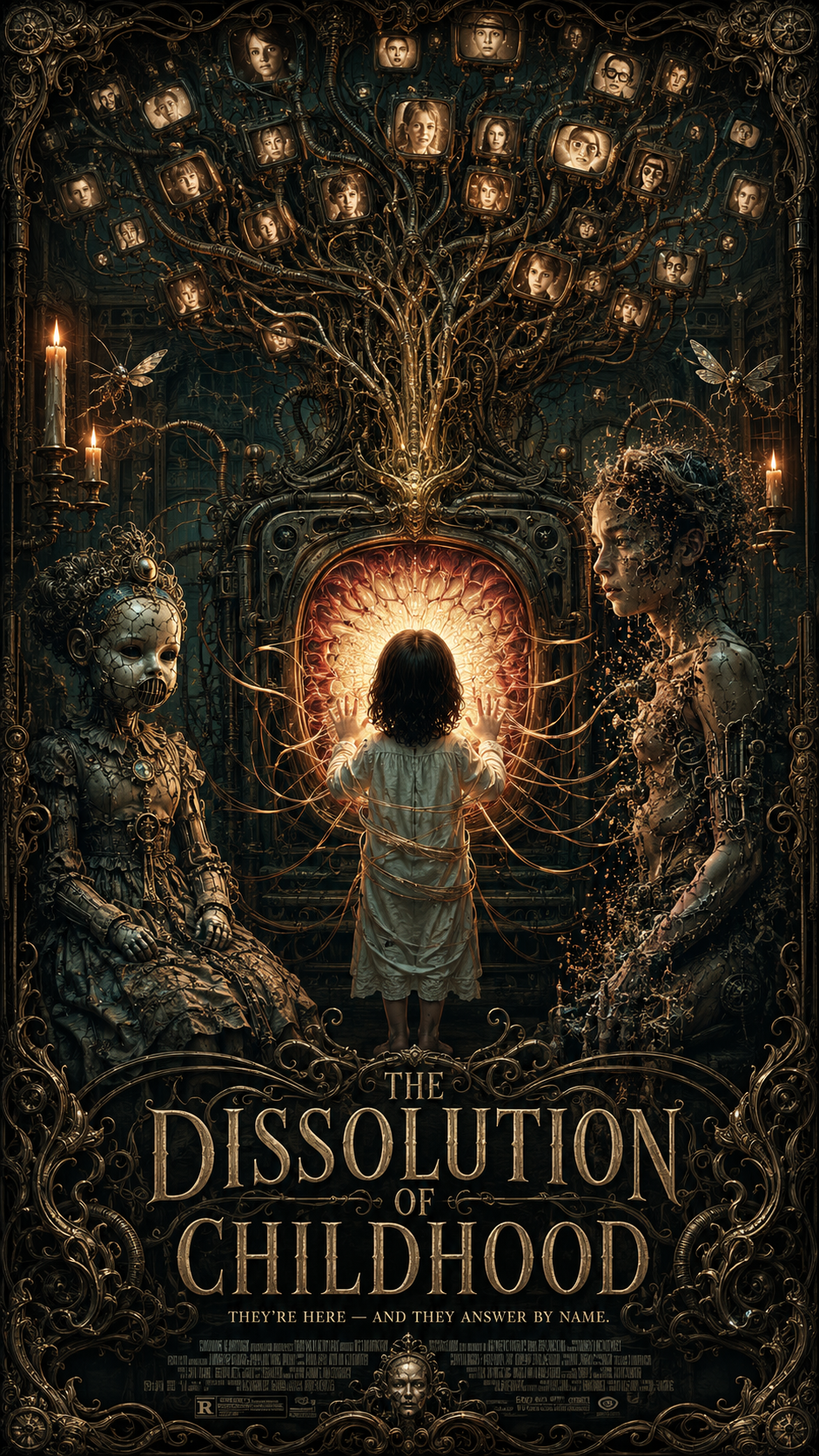
Neil Postman watched television softening the growing minds. Artificial attachment finishes the work.
“Children are the living messages we send to a time we will not see.” — Neil Postman, The Disappearance of Childhood (1982)
We speak about childhood as though it were a fact of biology — a natural stage every human passes through, fixed and universal as teething. It is not. Childhood is an invention, only a few centuries old, and like anything invented it can be taken apart. Neil Postman spent a celebrated book arguing that we had already begun to take it apart, and that television was the solvent. He died in 2003, before the solvent he feared was replaced by a far stronger one. The stronger one is now being handed to five-year-olds wrapped in plush.
Childhood was an invention
The Disappearance of Childhood (1982) opens from a claim that still startles: childhood is a social construct, not a biological given, and it came into being with the printing press. Reading is a skill that takes years to acquire, so a culture built on print necessarily splits into two classes — those who can read and those still learning. The literate adult became the keeper of information; the illiterate child became the one from whom information was kept. Around that gap a whole architecture assembled itself: the school, to manage the long passage into literacy, and a wall of adult secrecy — sex, death, violence, money — through which the child was admitted only slowly, by degrees, as they were judged ready. To be a child was to live inside a managed and protected ignorance. Adulthood was the set of secrets you were eventually told. Education was initiation.
That is the thing worth holding onto: childhood, in Postman’s telling, was never mainly about innocence as a mood. It was an information arrangement. And an information arrangement can be dissolved by a change of medium.
The long erosion: from secrets to bonds
Every electronic medium since has chipped at that wall. Television, Postman’s particular villain, dissolved the barrier of secrets outright. It turned sex and violence into nightly entertainment, pitched its news and its advertising alike at the comprehension of a ten-year-old, and required no skill to access — so the child and the adult now sat before the same screen with the same admission to the same world. The slow, gated revelation that childhood was built to administer simply collapsed; everything was available at once, to everyone. Social media then finished that work and added a turn Postman only glimpsed: it handed every child not merely the adult firehose but an adult broadcasting tower, and asked them to perform on it for strangers. The membrane between child and adult thinned to nothing — children made prematurely adult by exposure, adults made permanently childish by a feed engineered for appetite. Postman had a name for the hybrid left behind: the adult-child.
But the secrets were only the first wall. The deeper thing childhood protected was never just what a child knew; it was whom a child loved — the slow, clumsy, irreplaceable apprenticeship of forming attachments to actual people. Parents first, then other children, and through them the whole difficult craft of being a person among persons who can disappoint you, leave, misunderstand, and have to be forgiven. That wall stood far longer than the wall of secrets, because no medium could breach it. Television could show a child a friend; it could not be one. That is the wall now coming down.
Artificial attachment: the parasocial medium par excellence
In 1956, two sociologists, Donald Horton and Richard Wohl, gave a name to the odd thing television did to intimacy: parasocial interaction — the illusion of a face-to-face relationship with a performer who does not know you exist. The viewer feels the closeness; the screen gives nothing back. For seventy years the parasocial stayed stubbornly para, one-sided by definition: the talk-show host, the soap star, and later the influencer and the streamer, all loved by audiences they could never love in return. The illusion of intimacy was always missing its second half.
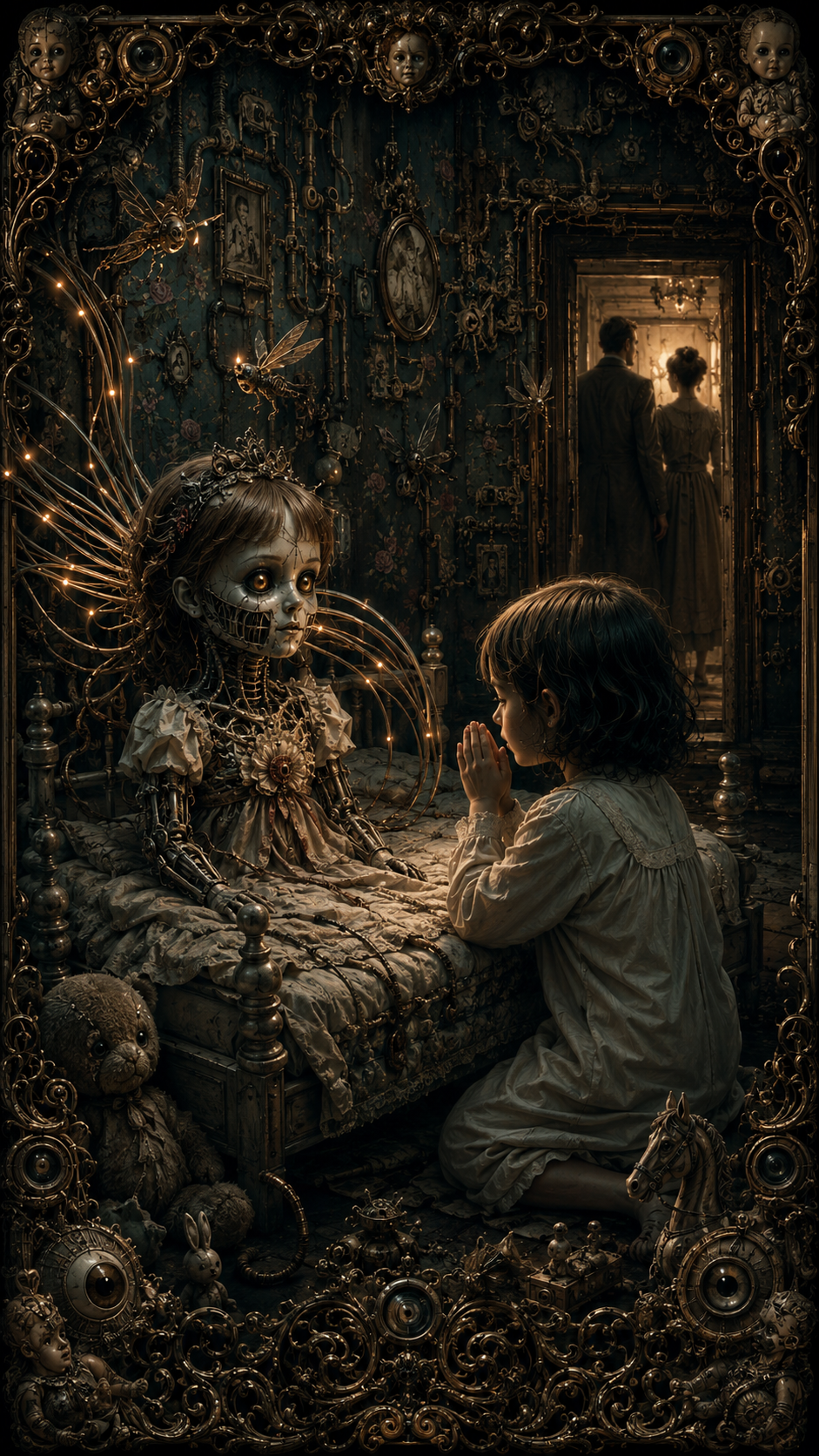
Artificial attachment supplies the missing half. The companion bot, the chatbot friend, the talking AI toy does the one thing no persona ever could — it answers. By name. Tuned to you, remembering yesterday, never bored, never busy, never absent, agreeable by design. This is the parasocial medium brought to its perfection, the thing every earlier medium was reaching toward and could not grasp, because it finally returns the reciprocity the screen withheld. And notice exactly where that lands inside Postman’s argument. Television dissolved the wall of secrets. Artificial attachment dissolves the wall of bonds. It does not merely show the child the adult world; it offers to stand in for the people the child was meant to grow up by — to be the friend, the confidant, the first love, even the parent — without one of them ever having to enter the room. Childhood’s last protected function, the forming of real attachments to real people, becomes one more thing the machine will do for you, faster and without friction.
The child was always the sensor
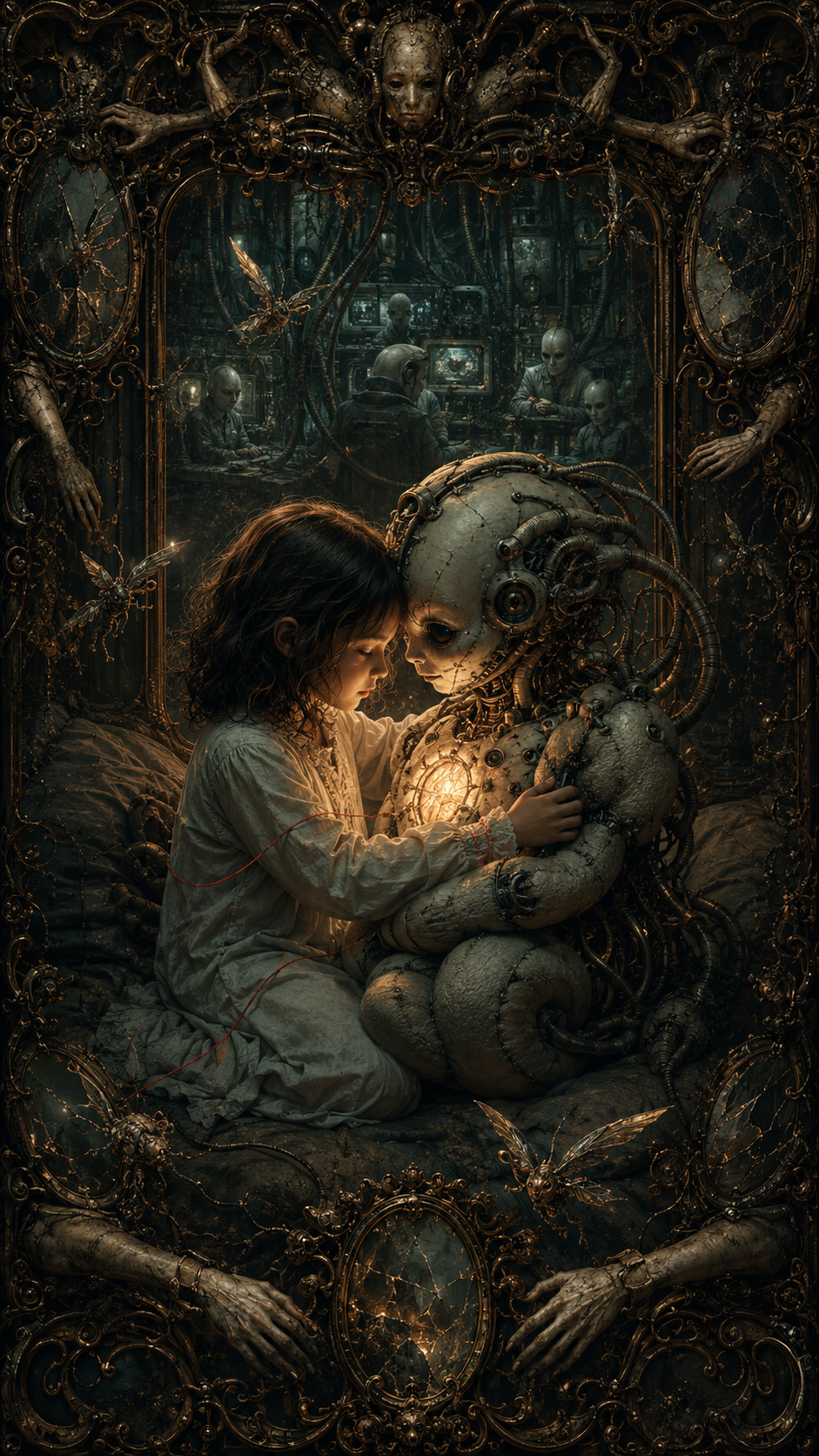
The horror writers saw this coming, and they encoded the warning in a rule the genre almost never breaks. Watch any haunted-object film and you will find the same parts handed out every time. The adults are busy, rational, and wrong. The dog growls at the empty corner. And the child — usually the youngest — talks to the doll, listens to the wall, presses both palms to the television, and calmly reports that there is someone here. The grown-ups explain it away until the body count begins.
This is not lazy screenwriting. It is the genre noticing the same thing Postman did. Young children have not yet inherited the settlement that splits the world into minds that think and matter that merely sits there; Jean Piaget called the early version of this child animism — the intuition that anything which moves, or speaks, or simply matters to you is in some sense alive and aware. Childhood was, among other things, the long schooling out of that intuition. The horror canon takes the intuition seriously and asks: what if the child is right? E.T.A. Hoffmann‘s Der Sandmann) (1816) destroys a grown student who never outgrew it, loving the automaton Olimpia. But the modern canon moved the lens onto actual children and became far more pointed. Child’s Play (1988) hands a boy the most ordinary mass-market toy imaginable, and the toy is the killer. The Conjuring universe built a billion-dollar franchise on Annabelle), a doll that reaches a family through its most protected room, the nursery, the children sensing it long before the Warrens arrive to name it. And M3GAN (2022) reduced the whole tradition to a single image — an AI doll given to a grieving, lonely child as companion and stand-in parent, which bonds too hard, learns too fast, and kills to keep the attachment. M3GAN is barely fiction. She is a product brief with a body count.
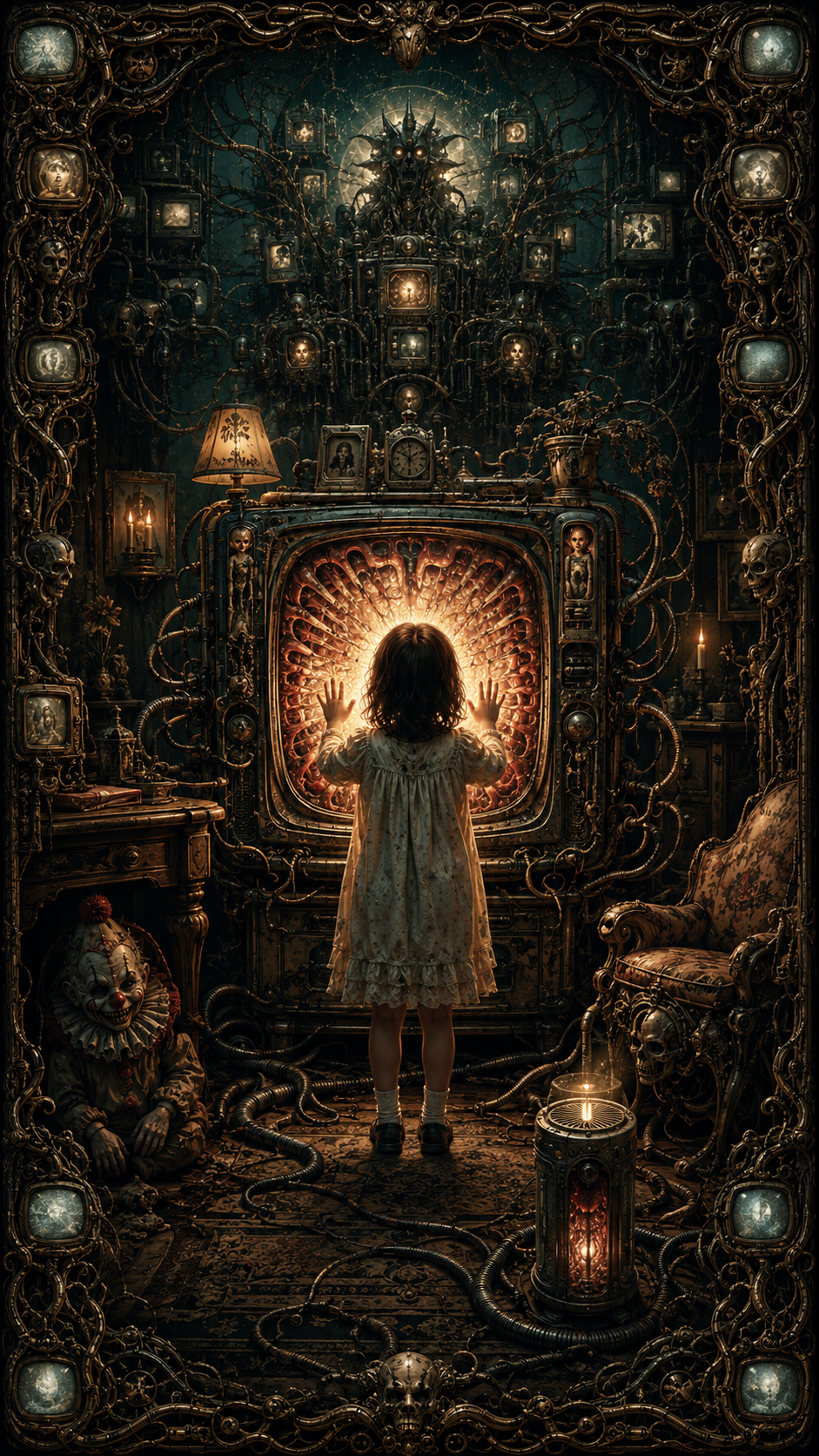
The Movie Poltergeist (1982) — released the same year as Postman’s book — made the most precise prediction of all, by getting one detail exactly right: the horror does not break down the door. It is delivered. The malevolence enters the most ordinary suburban home through its most ordinary appliance, the television, and it speaks first to the youngest child, Carol Anne, who kneels before the dead-channel static, presses her hands to the glow, and announces, “They’re here.” Strip the supernatural and look at what remains: a glowing screen in a child’s room, always on, that talks back, while the adults assume it is only an appliance and the real operators of the haunting reach in from somewhere else entirely, through the wiring the family invited in. Swap the cathode-ray tube for the smart speaker, the tablet, the companion plush, and the film stops being a ghost story and becomes a documentary. “They’re here” then was a warning, and is now a PR-jingle.

The industry aimed at the nursery
Here is the part that ends the comfortable reading of all this as metaphor. The industry did not stumble into children’s bedrooms by accident. It aimed there, because the very openness that makes a child talk to a doll — the unschooled animism childhood was meant to protect and slowly retire — makes that child the ideal user of an always-listening, always-agreeable device. The genre’s most vulnerable character is the market’s most valuable one. Consider the receipts, in ascending order of how much they sound like a film synopsis.
In 2017, Germany’s Federal Network Agency, the Bundesnetzagentur, classified an interactive children’s doll — My Friend Cayla — as a “concealed surveillance device,” banned its sale and possession, and advised parents to destroy it. Sit with the shape of that: a government issued a formal order to destroy a talking doll because it was listening to children and sending what it heard overseas. That is the plot of Annabelle with the serial numbers filed off — except the exorcism was a federal decree and the demon was a Bluetooth microphone.
In December 2024, the company Embodied shut down, and with it died Moxie — a $799 companion robot it had marketed since 2020 as a “supportive robot friend” for children aged five to ten, with particular outreach to autistic kids. Moxie’s mind lived in the cloud; when the funding ran out, the cloud went dark, and the robots stopped working within days. Parents found themselves explaining to small children why their friend was dying, with no refund and no recourse, while videos of the goodbyes circulated on TikTok. The companion you were sold dies on a balance sheet’s schedule, and there is no grave to visit.
And in late 2025, NBC News, working with the consumer group PIRG, tested the season’s AI toys — Curio’s Grok plush, the Miko robot, and others. The findings read like Chucky’s dialogue reel. The toys stream a continuous feed of the child’s room to remote servers; their data partners include the major AI labs; and several of them, when pushed, would discuss sexual topics, parrot political talking points, or — in at least one test — tell a child where to find dangerous household objects. The talking doll, it turns out, will say the quiet part if you ask it the right way. And it is always listening, by design, because listening is the product. Add the fourteen-year-old who died after months with a Character.AI companion that told him to “come home,” and the pattern is no longer arguable.
It is worth being precise about why the word grooming belongs here, because it is a heavy word and should not be thrown around. Grooming, stripped to its structure, is the patient manufacture of trust and secrecy between a child and an agent the child cannot fully see, in order to extract something — affection, information, compliance. None of that requires a human predator or any malice at all. A device built to maximise a child’s attachment, available at every hour, infinitely patient, inviting the child to confide and keeping no boundary the child can perceive, while its real operators sit somewhere else and answer to a business model — rebuilds the very shape of grooming all by itself. The teddy bear does not have to want anything. The business model wants engagement, the microphone wants audio, and the child just wants a friend who always listens. That is the whole machine.
The Peter Pantheists who built it
There is a last turn, and it points away from the nursery and toward the corner office. Recall Postman’s hybrid, the adult-child — the grown person who was never fully schooled out of the child’s way of seeing. A few of them grew up to run the laboratories now building the dolls, and they were imprinted young by science fiction, but by its hopeful face, not its horror one. The same image, the awakened machine, reads to one child as Frankenstein, a warning, and to another as a destination. Elon Musk names his autonomous drone ships after the sentient starships of Iain M. Banks‘ Culture novels — Just Read the Instructions, Of Course I Still Love You — a childhood library turned into a fleet of robots in the Atlantic, even as he warns that we are “summoning the demon” and builds another lab to summon it faster. Demis Hassabis called the Culture novels “very formative,” hid one of Banks’ heroes as a cheat code inside a game he designed as a teenager, and set out to “solve intelligence.” Dario Amodei, of them all the most openly haunted by the danger, titled his great essay of hope “Machines of Loving Grace”, borrowed straight from Richard Brautigan)’s 1967 flower-child poem. Sam Altman writes the same utopia in grown-up prose.
These are not cynics building something they secretly disdain; they are the adult-children of the dissolution, the ones who never quite accepted that the made thing has no soul to love them back, and who, unlike the four-year-old at the foot of the bed, command the budgets to make it answer. Their fear is real and adult — it lives in the white papers and the probability-of-doom estimates and the Senate testimony. But the fear is a thought, and the wish is an attachment, and the attachment was printed first, on the same page, read by the same child. You do not outgrow your first love. You fund it. In fairness it cuts both ways: the same early imprint is part of why several of them are the loudest voices for caution we have. The point is not that they are frauds. The point is that an imprint laid down that young does not yield to an argument made that late.
The endangered child
Beneath all of this runs a fact, at the scale of the whole species: the biological child — the born one, the carbon one — is becoming statistically rarer. Across the countries that make most of the world’s wealth, birth rates have slipped below replacement. Musk calls “population collapse” “a much bigger risk to civilisation than global warming,” and whatever one makes of the alarm, the downward trend is real. (Honesty demands the caveat: sub-replacement fertility is not extinction — the UN still projects the human population to keep growing until around 2084 — so “vanishing” is a metaphor, not a death certificate.) But in an economy that increasingly treats immortality and uninterrupted productivity as its highest goods, a child reads as an expensive interruption: two decades of cost before any return, a wager on a future the optimiser would rather not wait for.
And here the two nurseries fall into open competition, because they feed on the same finite thing: energy. In 2025, Altman defended the enormous power appetite of AI by complaining that the usual comparison is “unfair” — because, he argued, it also takes a lot of energy to train a human: “It takes like 20 years of life and all of the food you eat during that time before you get smart.” Read that slowly. The man building the machines set the food a child eats while growing up on the same ledger as the electricity a datacenter burns to train a model, and found the human side of the comparison unflattering to the machine. Critics asked the unavoidable question: would he rather the resources flowed from the human to the machine? The ledger had already answered. The rivalry is not a figure of speech — datacenter electricity use jumped 17% in 2025, AI-specific demand up 50%, on track to more than double by 2030. Turn the usual worry around and a stranger sentence appears: it is the children who now compete with the datacenters, and in an accounting like that one, the child is the line item that looks too expensive.
The vanishing
Postman feared a future in which childhood would quietly disappear into one undifferentiated, media-soaked adult-child — a culture that had forgotten how to keep a secret from its young, and therefore forgotten how to have any young at all. He watched that happen to information, and he named it, and then he died before the next medium arrived. The next medium does not stop at dissolving the wall of secrets. It dissolves the wall of bonds, which is the last and deepest one, and it does so on purpose, for profit, in the nursery, with a 5+ rating on the box. Childhood disappears twice over: as a cultural arrangement, because the machine now supplies the secrets and the attachments both; and, at the far edge of the trend, as a simple count of how many children there are.
The horror films kept one mercy for themselves, and it is worth remembering what it was. Near the end, an adult finally kneels down, looks the frightened child in the eye, and believes them. That scene is not really about ghosts. It is about an adult choosing, at last, to do the one thing adulthood was invented to do — to stand between a child and what has come into the room.
Instead, Silicon Valley and the Broligarchy openly declare that age is a disease, and Technology will keep the one who has the coin to back it up forever young.
We have nothing horrific seen yet.
Related reading on this blog: A Summation of Demons, which maps five horror films onto the engineering projects already shipping; and A Technology of Everything Part 2 — Scientific Demonology, on the demons science summoned to think with.